
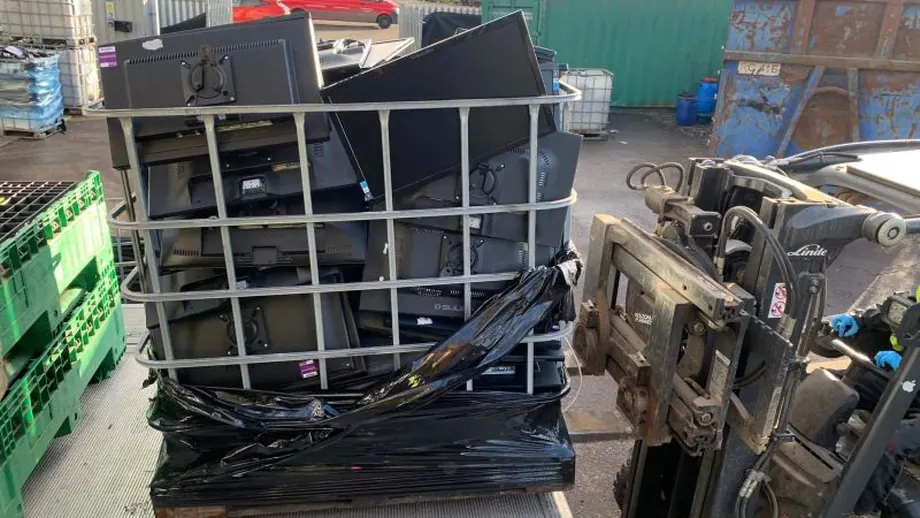



Cages of IT equipment sorted for WEEE recycling.

What are the WEEE regulations for businesses?

By Andy Pedley, Director. Updated October 12, 2026.Andy runs Secure Transportation Ltd, which has been trading since 1996 and works from Church Crookham, Fleet, Hampshire.

The WEEE regulations say business electrical and electronic waste must be kept out of general waste, collected by a registered carrier, treated at an authorised facility, and documented. In the UK that's the WEEE Regulations 2013, which implement the EU WEEE Directive 2012/19/EU. We're a carrier and disposal partner, not a compliance scheme.

When
Where
Cages of IT equipment sorted for WEEE recycling.

What WEEE means

WEEE stands for waste electrical and electronic equipment. It's anything with a plug, a battery or a circuit board that you've finished with: computers, laptops, monitors, servers, network kit, phones, printers, cables, lamps, and larger equipment such as air conditioning units and vending machines. If it ran on electricity and it's now rubbish, it's WEEE.

WEEE recycling is treating that equipment at an authorised facility so that the metals, plastics and other materials are recovered instead of buried. Our own WEEE recycling partner is a regulated Approved Authorised Treatment Facility (AATF), and the precious metal goes to approved refiners, so nothing goes to landfill.

Who the regulations apply to

The WEEE Regulations 2013 put duties on several groups: producers who put electrical goods on the market, distributors and retailers, and the businesses that use the equipment. This guide is about the last group, because that's who we work for.

If you're a producer or you sell electrical goods, you also have registration and take-back duties through a compliance scheme. That's a separate arrangement, and we don't provide it.

For a business user the principle is simple. When you stop using electrical equipment, you've got to dispose of it properly, and you stay responsible for it until it's been dealt with. Handing it to anyone with a van doesn't end that responsibility.

WEEE requirements for a business, step by step

  • 1. Separate it | What to do: Keep WEEE out of general waste and skips. | What to keep: A list of what you've set aside
  • 2. Remove the data | What to do: Have data bearing devices destroyed before the equipment is recycled. | What to keep: A certificate of destruction listing makes and serial numbers
  • 3. Use a registered carrier | What to do: Check the carrier's waste carrier registration. Ours is upper tier, CBDU551195. | What to keep: The carrier's registration details
  • 4. Use an authorised facility | What to do: The equipment should go to an AATF or an equivalent authorised treatment route. | What to keep: The facility's certification
  • 5. Get the paperwork | What to do: A waste transfer or consignment note for each collection. | What to keep: The notes, filed against your asset list
  • 6. Keep the records | What to do: Hold them for as long as the current regulations require, and check that period when you file. | What to keep: A single reference that ties list, notes and outcome together

Our free WEEE and Environmental Reporting Template puts those records in one report, and it's written for IT, facilities, sustainability and compliance teams who need figures for an environmental report or evidence for an auditor.

WEEE categories, hazardous waste and codes

The regulations sort equipment into categories, such as large equipment, small equipment, small IT and telecoms equipment, screens and monitors, lamps, and temperature exchange equipment like fridges and air conditioning. The category matters mostly to producers and to the treatment facility. For a business user the question is simpler: is it electrical, and have you finished with it?

Some WEEE is hazardous. Screens, lamps, batteries and certain components can contain materials that need proper treatment, so it should never go in with ordinary waste. A hazardous item mixed into a mixed load is a common reporting gap.

Waste also has a code from the European Waste Catalogue, known as the EWC code. Your carrier and the treatment facility put the right code on the waste transfer note, so you don't have to look one up yourself. We don't quote code numbers here, because the right one depends on what's in the load.

Where WEEE goes after collection

It goes to an authorised treatment facility. At ours the equipment is stored for reuse, recycled or donated, and the certification comes from the AATF. In April 2021 we took two van loads of waste IT from Wiltshire to a WEEE facility, and in December 2024 we removed old monitors from 160 desks with WEEE certified disposal.

What about the data

WEEE rules cover the equipment, not what's on it. A laptop that's perfectly good WEEE can still be a data breach.

That's why we shred the drives before the recycling, scan in every serial, and give you a certificate of destruction. The full sequence is in our guide to the IT asset disposal process.

WEEE regulations questions

Waste electrical and electronic equipment. It's the label for anything electrical or electronic that has reached the end of its life.

They're the WEEE Regulations 2013, which implement the EU WEEE Directive 2012/19/EU. For a business that uses the equipment, they mean keeping WEEE out of general waste, using a registered carrier and an authorised treatment facility, and keeping the paperwork.

Large equipment, small equipment, small IT and telecoms equipment, screens and monitors, lamps, and temperature exchange equipment. Most of what we collect falls under IT and telecoms equipment and screens.

Some of it is. Screens, lamps, batteries and certain components can contain hazardous materials, so WEEE shouldn't be mixed into general waste. Your carrier and treatment facility deal with that classification on the paperwork.

EWC stands for European Waste Catalogue, and each type of waste has its own code. The code goes on the waste transfer note, and your carrier and treatment facility complete it. We don't quote numbers because the right one depends on the load.

To an authorised treatment facility, where it's reused, recycled or recovered. Ours is a regulated AATF, which issues the certification.

Separate it, have any data destroyed, hand it to a registered carrier, and keep the transfer note and the treatment certification. We can do all of that for you. See business WEEE disposal.

Keep WEEE out of general waste, have the data bearing devices destroyed, use a registered waste carrier and an authorised treatment facility, and keep a waste transfer or consignment note for every collection. The table above goes through each step and what to keep.

Yes. Cables, chargers and power supplies are electrical items, so they count as WEEE when you've finished with them. Computers, monitors, servers and network kit are the commonest examples.

Related guides

We reply to every enquiry. Your details are used only to answer it. Privacy notice

Thank you, your enquiry has been sent

We have your details. Someone from the team will read it and come back to you by phone or email.

We reply to every enquiry. Your details are used only to answer it. Privacy notice

Thank you, your enquiry has been sent

We have your details. Someone from the team will read it and come back to you by phone or email.

CallGet a quote