


Services
Every asset scanned and serialised before it moves, reconciled against your own inventory, and scanned again at the other end. What left is what arrived, and you have the list to prove it.
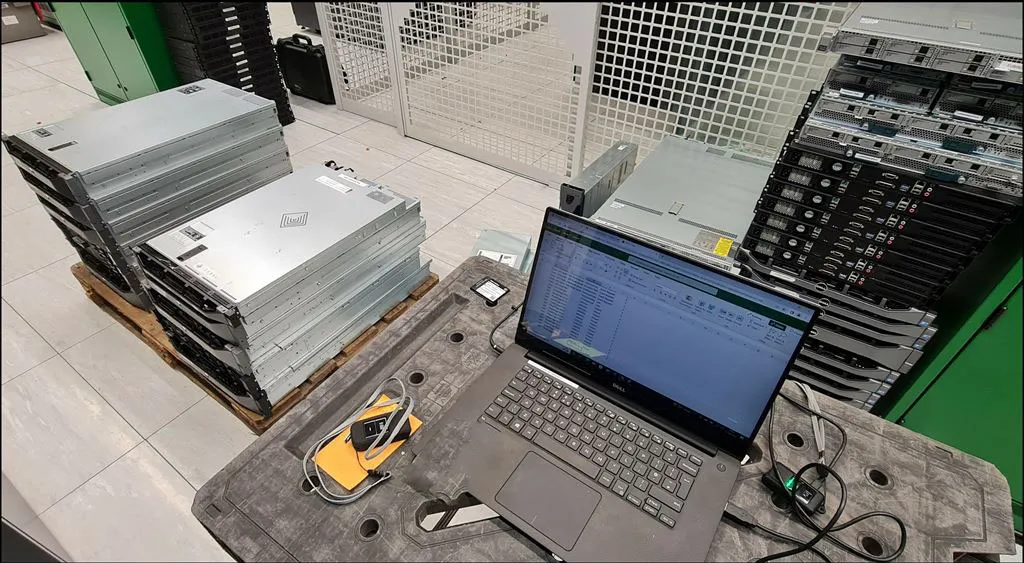
An asset audit is not glamorous. It is usually the thing that stops a migration going wrong, because we compile our own register on site, cross-reference it against whatever inventory you already hold, and where the two disagree we tell you before move night rather than three weeks afterwards. Devices are labelled by rack or desk position, accessories are bagged and labelled with them, cases carrying anything sensitive are closed with tamper evident seals whose numbers go on the register, and everything is scanned at each handover, which is what chain of custody means in practice. The output is a clean list you can put in front of finance, security or your CMDB team.

Yes, and most of this work happens at night anyway, because that is when the change windows are. Each site gets its own manifest, scanned at the point of collection and signed off at handover, so a load never merges into an unlabelled pile in the back of a van. Equipment travels under tamper evident seals, the numbers logged against the asset list, in our own plain vehicles, deadlocked, tracked to street level and driven by our own people rather than a subcontractor who has never met you. If kit stays with us overnight it sits in a warehouse alarmed to an NSI Gold centre with police response. The record runs start to finish.
Yes. We build our own asset register as we work, capturing make, model and serial with a handheld barcode scanner, then cross-reference it line by line against the inventory list you give us. You get it back as a spreadsheet with whatever fields you need, typically serial, make, model, asset tag, site, rack or desk position and condition, which imports into most asset registers without much argument. We are not going to pretend we plug straight into your CMDB. What we will do is hand over clean data in the format your team asks for, and flag every item that was on your list but not on the floor.
It is the simple business of proving that the exact machines that left one building are the exact machines that arrived at the other. We scan make, model and serial with a handheld barcode scanner at the point of decommission, scan again at the destination and compare the two lists, and anything that does not match gets raised on the spot rather than three weeks later when nobody can remember which rack it came out of. It matters. A missing serial is an insurance argument you will lose, and on an ITAD job the certificate of destruction is only worth anything if the serial printed on it came off a real drive.
Send site addresses and an approximate asset list. We will return a secure plan and confirmed date.