
Services
We move medical and scientific equipment on our own vehicles, with our own handling kit and our own people, anywhere in the UK and Europe. Nothing gets handed to a network.
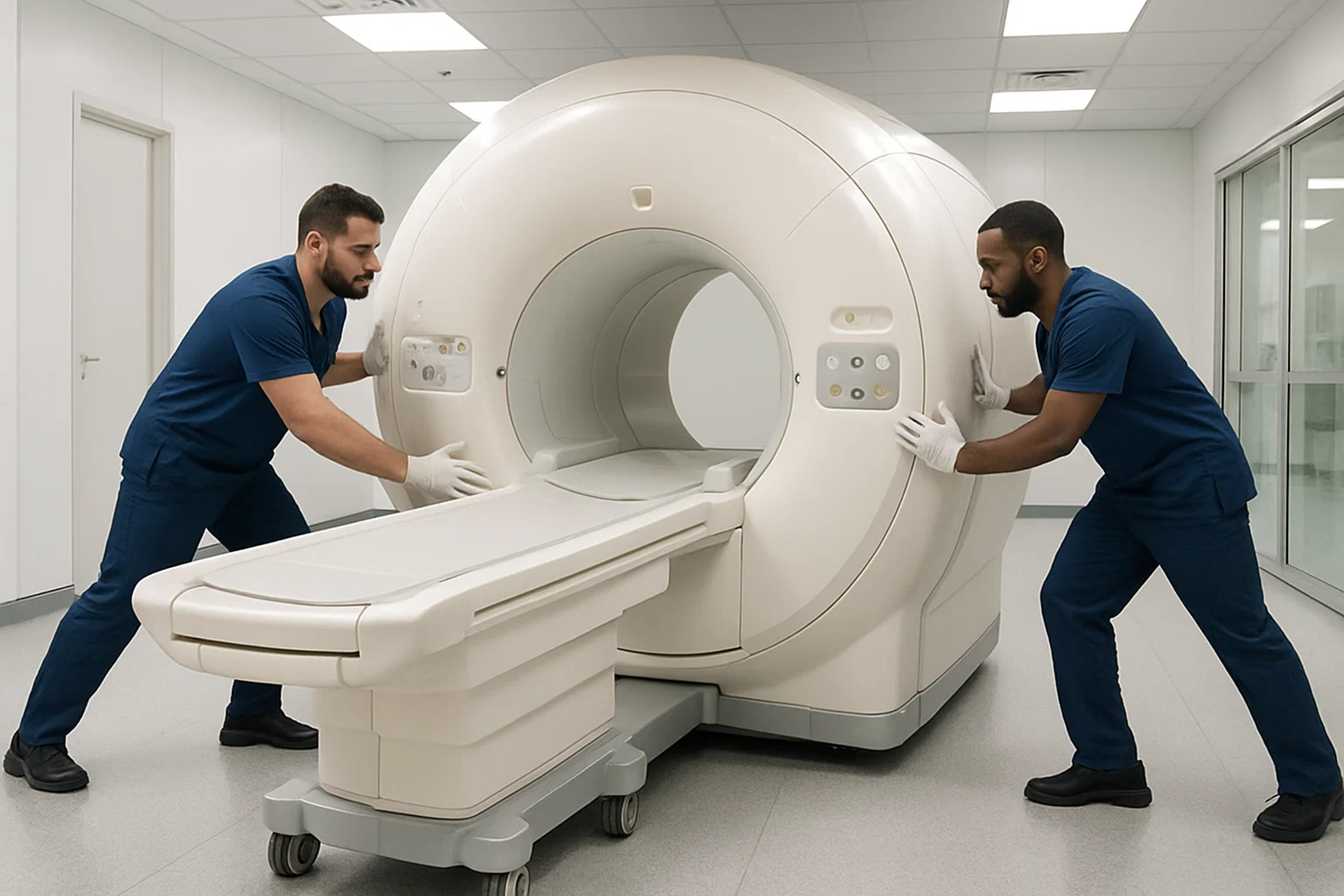
Most of what goes wrong with a delicate instrument happens in the last fifty metres, not on the motorway, which is why we turn up with an Innolift mobile fork truck that lifts 600kg off the tail lift without a forklift on site, a pair of scissor lift tables and a powered stair climber, rather than a two person team and a sack barrow. Crews are DBS checked and security vetted, and on a live site they work to infection control procedures agreed with the estates team beforehand. Vehicles are air ride, Euro 6 and tracked to street level across Europe. ISO 9001:2015 accredited.


Yes. Collections across Europe run on our own vehicles under our international operators licence, with our own in-house customs agent doing the entries, which needs a Power of Attorney signed by one of your company officials before we can act for you. Where the equipment is going out and coming back, a demonstration unit or a loan instrument, an ATA Carnet usually suits better than a standard declaration. Everything is scanned by serial at collection and signed for at handover, the vehicles are air ride and tracked down to street level, and delivery is to the room of choice at the hospital or laboratory rather than the goods-in door. Plan around European customs hours, which end at 4pm.
Yes, and it is a large part of what we do. The blue PowerMate M-1 is the heavy machine, rated to 682kg on a flat surface with two operators and 454kg going up or down stairs, and its drop down frame means the same unit runs the load along the corridor afterwards. For lighter items the red Stanley SC620 takes 310kg at nine steps a minute and will manage 300 steps on a full battery charge. Before any of it moves we survey the route, the landings, the turns and the door widths, protect the floors and write the method statement around what the stairwell will actually allow. No lift, no problem.
It starts with a survey, because the route matters more than the item. We look at door widths, lift dimensions, floor loadings and where the thing actually has to end up, then write the risk assessment and method statement around what we found, before anything moves. Transport is on our own air ride vehicles, plain and un-sign-written, with straps, blankets, shoring poles and load lok holding everything still. On site we take it to the room of choice, position it, break down the packaging and take it away with us, and capture serial numbers with photographs. If there are stairs and the lift is out, the powered stair climbers travel with us. No lift, no problem. We can also hold kit at Hayes until the department is ready for it, in a temperature controlled area where the instrument needs one.
Send site addresses and an approximate asset list. We will return a secure plan and confirmed date.